Mortality's Morality
Grieving my parents forced a confrontation with mortality, and a reckoning with the morals and values of the people that raised me.

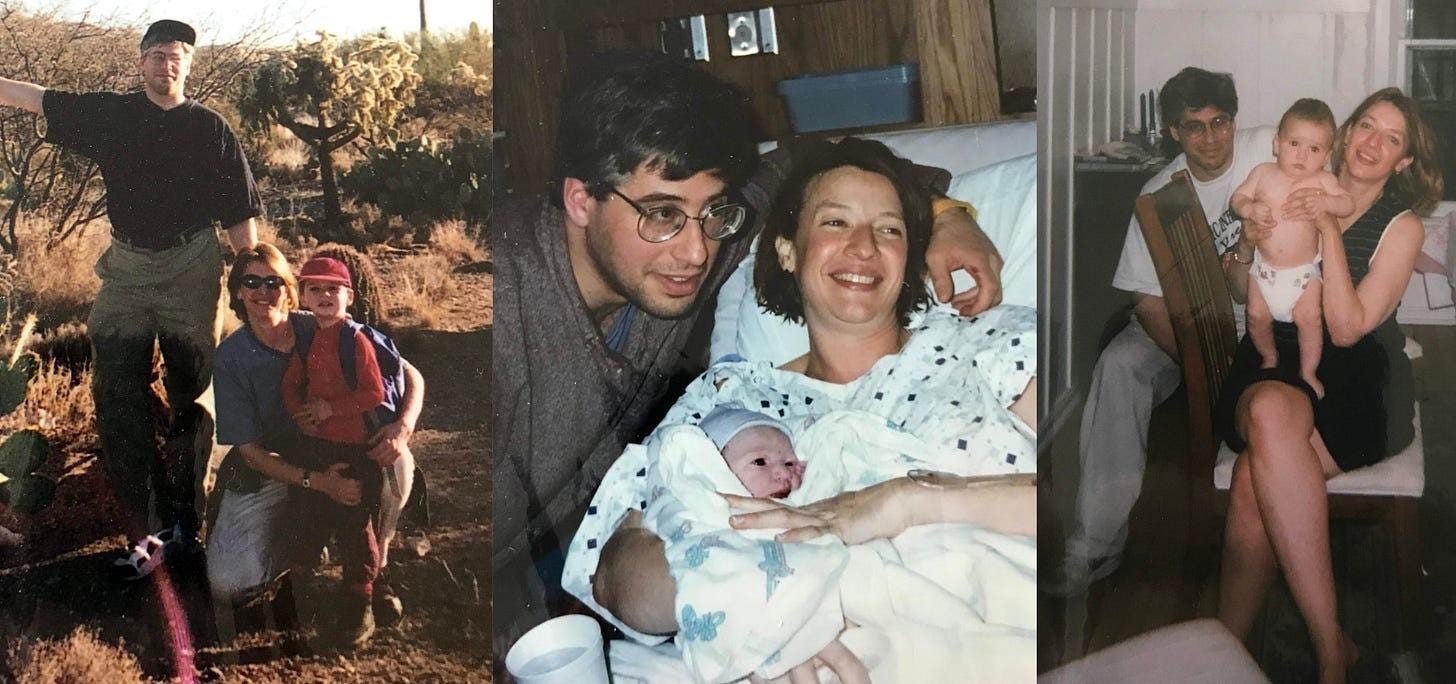
My father, Jonathan Rosenblum, died on June 5th. He was 67 years old. He raised me, an only child, as a single father from the age of nine after my parents separated, my mom’s alcoholism took over, and she died. In mourning, I’ve wandered down currents and eddies of my parents’ lives and what lessons they, and their early deaths, taught me.
My dad lived with a deep humanity. He spent his life loving people and their fullness, as a journalist, a writer telling the stories of striking copper workers, a labor attorney, and a singer-activist leading the longest continuously running singing protest at the Wisconsin State Capitol. He believed that every moment could be holy and every human was made in the image of one another. Therefore, an injury to one is an injury to all.
On our road trip to drop me off at college, he took us 300 miles out of the way to the Abbey of Gethsemane in Kentucky where Thomas Merton left his career, took a vow of silence, became a Trappist monk, and poured his meditations into his books. This week, I’ve repeatedly read a passage from Merton that distilled my father’s life philosophy:
In Louisville, at the corner of Fourth and Walnut, in the center of the shopping district, I was suddenly overwhelmed with the realization that I loved all these people, that they were mine and I theirs, that we could not be alien to one another even though we were total strangers… It is a glorious destiny to be a member of the human race, though it is a race dedicated to many absurdities and one which makes many terrible mistakes… There are no strangers!… The gate of heaven is everywhere.
—Thomas Merton, Conjectures of a Guilty Bystander (p. 153-154)
In the wake of his loss, I am also reminded of moments from the years after my mom died. She passed away when I was 14, on Christmas Eve in 2011. After her death, people started telling me “she’s with you.” I hated hearing that. She was only there in hazy dream-states in the early hours of the morning, or in the waves of memories that wracked my young mind each time I’d be reminded of her. I quickly realized I did not believe in an afterlife, at least in the traditional sense.
While grappling with the finality of her death, I began to imagine my own. Gripped with terror, I imagined everything I knew disappearing in an instant. I started waking up in those same early morning hours with my stomach in a knot, my mind on the edge of the void, realizing that I too would be gone someday. I didn’t want to die; I loved my life. I loved the people in it. I especially loved that there would be more of it, a future to be imagined, shaped, and pursued.
Grappling with the loss of both my parents revealed three personal truths: Every person is holy, death is final, and life is to be lived. Downstream of these truths come others: It is a sin amongst sins for a person to be forced to struggle their entire life. Any unnecessary death is a moral tragedy. Any society that fails to care for its people is guilty of a crime against humanity. These truths illuminate a moral system.
Two months after my mom’s death in 2011, Trayvon Martin was shot and killed by George Zimmerman. Martin was two years older than me, killed for walking to the convenience store because he was black. We marched from my high school to the Capitol, and I felt that surely there would be justice. I was shocked when the world tried to villainize this boy, and ultimately acquitted Zimmerman. This was a lesson. Months later, 20 children and six adults were murdered in the Sandy Hook shooting, and still we couldn’t ban bump stocks. In 2014, Mike Brown, two years older than me, was murdered in Ferguson. In 2015, Tony Robinson, another unarmed black teenager two years older than me, was shot and killed, this time by a Madison police officer just miles away from my home. These young men were holy, and their lives were sacred, and I watched as elected leaders tried to justify their deaths.
Inaction by those in power in the face of such blatant injustice, despite widespread outrage, highlighted a rot—not at the margins, but at the center of our world.
As I grew older, I saw this same story in a different tune. When I was 16, I worked at Noodles and Company where I made $8 an hour. I watched our deaf line cook work three jobs just to survive. At Harvard, I marched with dining hall workers on strike because the richest university in the world wouldn’t pay them enough to live. I worked two jobs on the side because the Madison Mallards, a summer college baseball team in my hometown selling 6,000 tickets a night, wouldn’t pay its players, and refused to give us gas money so we could get to the field. In 2018, I was drafted by the Tampa Bay Rays in the MLB Draft. Weeks later, I received my first paycheck: $550 for two weeks of work. I watched teammates skip meals daily just to send money home to their families. It took a 4-year battle and a 6,000 player organizing effort during which I lost my own baseball career to win even $20,000 minimum annual salaries.
Our world does not value life. That is the core truth I confronted. Our modern lives are built on death. Every piece of clothing, every button on my keyboard, every stitch on the baseballs I threw, were made by other humans whose lives were just as complex as mine caught up in a machine that ate their lives, spit out products, and made rich a tiny cabal of people for whom death is just fuel for more profit. Our economy rests on the blistered hands and bent backs of factory workers in India, the Philippines, and Bangladesh whose lives we value at $1.80 an hour. Our lifestyle rests on mine shafts and white hot smelters in Indonesia and Zambia where bodies crushed in rubble mark the passing of months, or sometimes weeks. Blood dripping down the cogs of the machines is just a sign of a productive week and a tiny bump in share prices.
And so, I fight for the world my mother and father didn’t live to see: A world where every life is holy, we understand the finality of death, and we build a society that allows life to be lived.
Whether sharing the struggle of striking mine workers in my father’s book Copper Crucible, gathering singers in the Capitol rotunda, sharing stories of forgotten communities as a journalist, or building his own patchwork community here in Madison, my father’s indomitable spirit directly opposed a world built on death. And so his death is even more unfair. He died before we birth a world where human life comes first, not the wealth or power of an elite few.
Jewish tradition says “may his memory be a blessing.” Yes, his memory will be a blessing in that it helps us see God everywhere, especially in the worn and aching hands of the garment worker, the wind-worn cheeks of the delivery driver, and the tired feet of the nurse. The gate of heaven is everywhere. כן יהי רצו ken yehi ratzon, may it be so.
Beautiful! Love that Merton quotation.
Your dad was so proud of you. He would have loved this piece beyond measure. You are the most amazing product of your amazing parents.